
How to buy a wind turbine – important hints and tips!
Buying a wind turbine or wind generator can be very difficult. Especially when you are considering to purchase a larger wind turbine system to achieve excess electricity to sell back to the grid. Whether you’re looking for a small wind turbine, residential turbine, an industrial megawatt turbine or an entire wind farm, we’re here to help.
We want to make sure that you buy the right wind turbine delivering you the right amount of energy for your requirements.
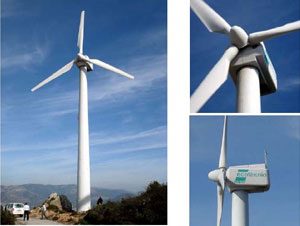
MyWindPowerSystem.com – the best Wind Power site on the internet knows your questions when it comes to purchasing a wind turbine system for your land to generate some extra cash for you from the freely available wind. We have combined here for you a list of answers to your questions which then follows a simple 13 Step-by-Step guide as to how to go about to find out if buying a wind turbine is the right decision to make.
Your questions will be:
- How do wind turbines work?
- Will I have to change the wiring in my house?
- Will I save money?
- What about towers?
- How much does a wind turbine cost?
- What size wind turbine would I need?
- How reliable are wind turbines?
- Will it help the environment?
- Do I have to take wind measurements for a year or more?
- What are the companies who sellwind turbines?
- Will my utility allow me to connect a wind power system?
- Will I have problems obtaining planning permissions?
How do wind turbines work?
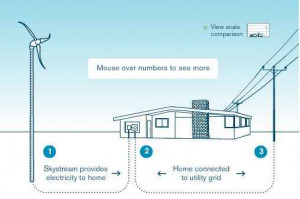
A wind turbine, which is installed on top of a tall tower, collects kinetic energy from the wind and converts it to electricity that is compatible with a home’s electrical system.
In a normal residential application, a home is served simultaneously by the wind turbine and a local utility. If the wind speeds are below cut-in speed (7-10 mph) there will be no output from the turbine and all of the needed power is purchased from the utility. As wind speeds increase, turbine output increases and the amount of power purchased from the utility is proportionately decreased. When the turbine produces more power than the house needs, the extra electricity is sold to the utility. All of this is done automatically. There are no batteries in a modern residential wind system.
Also, watch this high-quality video animation to see how wind power actually works and how the electricity produced by a commercially operating wind turbine to your home!
Will I have to change the wiring in my house?
No, Grid-tie converters can be connected to your existing power circuit. No. A wind turbine is easily retrofitted to virtually any home without the need to change any wiring or appliances. In most cases, the utility will install a second utility meter to measure how much surplus electricity it is purchasing from the turbine owner.
Will I save money?
Yes, if you purchase the right sized turbine and there is a sufficient wind at your location – The wind turbine typically lowers your electricity bill by 50 to 90 percent. It is not uncommon for wind turbine owners with total-electric homes to have monthly utility bills of only $8 to $15 for nine months of the year. In northern parts of the country where less air conditioning is used the bills can be very low year-round. The amount of money a small wind turbine or a large wind turbine system saves you and generates surplus income, in the long run, will depend upon its cost, the amount of electricity you use, the average wind speed at your site, and other factors such as costs for maintenance. The economics of a wind system are very sensitive to the average wind speed in the area, and to a lesser extent, the cost of purchasing electricity. As a general rule of thumb, a turbine owner should have at least a 6m or better 7m-10 m/s average wind speed per annum at his site and be paying at least 10 cents/kWh for electricity.
Will I make money?
Yes, provided your system is able to generate excess energy with the wind available at your site location. A small wind turbine typically lowers your electricity bill by 50 to 90 percent. It is not uncommon for wind turbine owners with total-electric homes to have monthly utility bills of only $8 to $15 for nine months of the year. In cooler parts of your country where less air conditioning has used the bills can be very low year-round. But if you want to generate extra income, you must opt for a larger sized wind turbine to be able to produce excess electricity and to achieve a sound return on your investment. This should be no less than 45,000 kWh excess electricity generated by your wind turbine system per annum. As a general rule of thumb, in order to generate a profitable additional income, a turbine owner should receive at least 10 cents/kWh for the excess electricity sold back to the local grid utility.
What about towers?
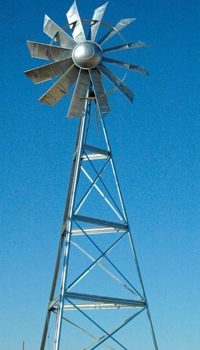
Different sized towers are usually available for any size wind turbine. Minimum tower sizes are 80- to 120-foot which are usually supplied along with the wind turbine. Towers this tall are necessary to raise the wind turbine above turbulence generated by obstacles on the ground and trees. Wind velocity and, therefore wind turbine performance, increases with altitude. Several different types of towers are available, depending on which manufacturer you select. Each type has its advantages; the most economical type of tower is the guyed lattice tower, but a hinged tower can be easier for you to install yourself and provides easier access for maintenance. However, larger turbines require steel towers for which a sound foundation must be constructed.
How much does a wind turbine cost?
Smaller sized turbines cost $6,000 to $22,000 and larger sized turbines start at approx. $50,000 for a 20Kw system up to $200,000 for a 100Kw system and $300,000 to $3,000,000 for turbines in the range of 250kW – 2,500kW
How reliable are wind turbines?
Wind turbines have very little moving parts and do not require any regular maintenance. However, moving parts are required regular maintenance (usually once or twice per annum) and it is not unheard of turbines operating for up to 25 years if maintained and serviced regularly.
Will it help the environment?
Yes, any non-carbon dioxide power generating device will help the environment. Wind turbines produce no pollution and by using wind power you will be offsetting pollution that would have been generated by your utility company. Over its life, a small residential wind turbine can offset approximately 1.2 tons of air pollutants and 200 tons of greenhouse gases (carbon dioxide and other gases which cause climate change). Larger turbine systems offset multiple times more than this.
Do I have to take wind measurements for a year or more?
No, but a wind assessment will be necessary – more details later on but generally, wind resource data published by the U.S. Department of Energy is sufficient for an experienced evaluator to predict wind turbine performance. In very hilly or mountainous areas, however, it may be best to collect wind data before purchasing a system to ensure that your site is not in a sheltered area.
Do wind turbines make noise?
Yes, but a modern residential wind turbine at a distance of a 50m is no noisier than a combination boiler working in your basement. However, it is recommended for large sized, industrial sized wind turbines starting from 100kW upwards to be installed at a greater distance to your home usually at a distance of at least 150m+
What are the companies who sell wind turbines?
There are many manufacturers and dealerships providing professional sales and after service.
Simply ‘Google’ the term ‘Wind Turbines For Sale’ and the search results will usually show you a large list of local and professional wind turbine suppliers from your local area.
Most dealers also offer either complete turnkey (ready-to-operate) installations or the option to purchase directly from the factory and install the system yourself. The first option offers more customer support from the company. Self-installation offers significant savings and a hands-on understanding of the turbine. Prospective owners can discuss the options available with manufacturers to decide which method best suits their budget and technical skills. However, for larger sized wind turbines, self-installation is not really an option unless you are a wind turbine installation manager yourself and all you need is to hire a construction firm to undertake the necessary work under your supervision. More details at our home page www.MyWindPowerSystem.com
What size turbine would I need for my home or business?
A wind turbine can be a relatively large device and is not suitable for urban or small-lot suburban homes and a property size of one acre or more is desirable.
Homes use is approximately 9,400 kilowatt-hours (kWh) of electricity per year (about 780 kWh per month). Depending upon the average wind speed in the area, a wind turbine rated in the range of 5 to 15 kilowatts would be required to make a significant contribution to meet this demand. Remember, if you want to generate extra income, your system needs to be able to produce excess electricity and to achieve a sound return on your investment, and as said before, this should be no less than 45,000 kWh excess electricity generated by your wind turbine system per annum.
Will I have problems obtaining planning permissions?
Not if the local township planning office has already granted planning permissions for wind turbines in your area before. Drive and look around in your local area and if you can or have seen operating wind turbines then it is most likely that obtaining a planning permission is just a technicality and a question of paying the necessary fees. However, you may live in an area oftern refered to as ‘Land of Outstanding Naturl Beauty’ which means that it is highly unlikely to obtain a building permit for larger scale wind turbines.

Want to go ahead and buy a wind turbine?
Here are the steps you take for a successful project:
STEP-By-STEP GUIDE to ‘How To Buy A Wind Turbine’
1.) First, you need to find out if there is enough wind at all available at your site location. Perform a rough wind assessment for your location by going to and enter your site location details. Note! The average yearly wind speed for your area should be at least 6m or better 7m-10m/s or higher per annum. You can also refer to Wind resource data published by your local Environmental Department or your Department of Energy
2.) Contact your local township or county planning office and find out the max. tower/hub height and max. rotor diameter for a wind turbine allowed in your area. You need to know this to establish what the maximum size turbine (by kWh output) you will be allowed to operate at your site location.
Now you know roughly how much wind is available at your location and you also know the max. rotor diameter and hub height allowed for a wind turbine to operate at your site. With this information, you are now able to estimate the amount of electricity likely to be generated by a given wind turbine over the course of a year. How do I get this estimate?
3.) Use the Annual Electricity Output Calculator at to calculate the expected yearly kWh output by entering the max. rotor diameter size given to you by your local town planning office ….make a note of the result and….. (don’t forget to come back here to read on)
4.) Calculate the average yearly electricity kWh consumption of your home or business.
5.) Subtract your average yearly kWh consumption from the estimated kWh generated. Is the result at least 45,000 kWh? If the answer is yes, then your site has the potential to generate extra income for you by harnessing the wind.
6.) Next step is to contact your local utility provider and ensure that ‘a net metering’ – ‘Buy Back Scheme’ is available.
7.) If yes, ask for the utility rate (¢ per kWh ) paid. The higher the utility rate is (¢ per KwH), the more economical your wind turbine system becomes.
8.) Multiply the utility rate (¢ per kWh) paid with the yearly kWh excess we have calculated earlier. This will be your estimated extra yearly income.
9.) Now if you want to go ahead – Contact your township planning office and obtain a special-use permit.
10.) Contact your local environment department – ask for grants available and apply for any available grant, no matter how small it may be. Remember, every little help.
11.) Now its time to go shopping! Go to MyWindPowerSystem’s Products page for professional & technical specialist advice on new Wind turbines with 500W, to 1Kw, 2Kw, 10Kw, 20Kw, 50Kw, 100Kw, 150Kw, 200Kw, 600Kw, 750Kw, 1Mw or even 1.5Mw power output or go to our ‘Renewable Marketplace‘ for used wind turbines, 12v converters, 24v converter, 48v, 3500w max/48v hybrid wind, 1500w modified sine wave converters, 6000w inverters, 500W, 1Kw, 2Kw, 10Kw, 20Kw, 50Kw, 100Kw, 150Kw, 200Kw, 600Kw, 750Kw, 1Mw, 1.5Mw used and second hand wind turbines, DIY wind turbines and micro wind turbines for both horizontal axis or vertical axis.
12.) Decide on a Grid-tie wind turbine package which is tailor-made to your requirements and budget.
13.) If the size of your turbine does not allow for Self-installation, decide on an ‘All In’ package from your dealer which would include construction work and installation or hire an independent project manager specialized in wind turbine installation and a local technical engineering or construction firm to work under his supervision.
Your project is completed – Go and harness the wind for a greener planet!
Your MyWindPowerSystem Team
You can also watch this great video to take you on a different trip to answer your questions while watching great images and listening to modern music and a mesmerizing soundtrack….enjoy!
I think you are over looking a great turbine in the Mariah Power Windspire. It is the best value at 1.2kW for $6500.00 and it is also a lot more athletically pleasing than some of the other ones you mentioned. Anthony Stonis admin@buildingenergyexperts.com http://www.buildingenergyexperts.com
Very detailed guide for choosing a good wind turbine system but most of them are for large wind turbines. If there are more detailed information about small wind turbines. It will be a great article.
A few comments on your site.
While it is possible to sell excess energy to a utility in a few locations in the US, the usual arrangement is net metering, which does NOT result in actual payments from anyone. Instead, any energy not consumed on site is sent to the grid through a production meter – or combination meter – and you are billed for what you have consumed. Any net excess is counted as a credit against your electric bill, but you will never receive a check from the utility.
Just like large turbines, which rely on several forms of subsidies to provide a reasonable ROI, small turbines used solely for grid inter-connection, without adequate government stimuli will not pay for themselves within the life of the machine UNLESS the electric rates are high and, of course, the wind resource is good.
Without good government programs to promote their implementation, small wind turbines are only a good choice when the application is off-grid or the cost of energy is high enough to make the investment worthwhile.
Second hand turbines are not eligible for incentive programs but, in some cases, can be purchased so inexpensively as to make them a viable option – especially in agricultural operations. However, since most of the used turbines on the market are wind farm take outs, it is extremely important that they have been re-manufactured and re-fitted with generators that are appropriate for use with American grids, and in a voltage that will not require the purchase and installation of very expensive transformers.
To add a few really good small turbines to your list . . .
Kestrel – 600 to 3,000 Watt models
Evance – 5,000 Watts
Air Dolphin – 800 Watts (but they will put out up to 4,000 in high winds)
Potencia Hummingbird – 5,000 and 10,000 Watts
Gaia – 11,000 Watts
Forget vertical-axis machines, at least until the laws of physics are changed.
i want to install industrial wind turbine of 1.5Mw in pakistan.looking for a good company who is interested in this project and help me in intallation with complete feed back.thanks
Hello from Russia!
Can I quote a post in your blog with the link to you?
Hey just looking for some advice. I am just about to purchase a 291 acre ranch in Oklahoma and I am looking for some power. I would like to be able to run everything in the ranch off of power I generate from the wind and I am wondering how much and how many I need. I have 4 out buildings all with power 220 service in two of them. A 3500 sq ft house and a built in pool. The pool will be heated with a wood burner system as well as the heat for the house everything else I want to run on wind turbines. What can you recommend.
thanks in advance for any advice.
Dana
I have no idea where to start. We have 3 homes on 155 acres plus a deep water well with a pump that always has problems, therefore, we are also interested in a windmill for that system. Info would be greatly appreciated. We live in a rural town in S.E. Oklahoma and want to stay local with our endeavor. Thanks!!